
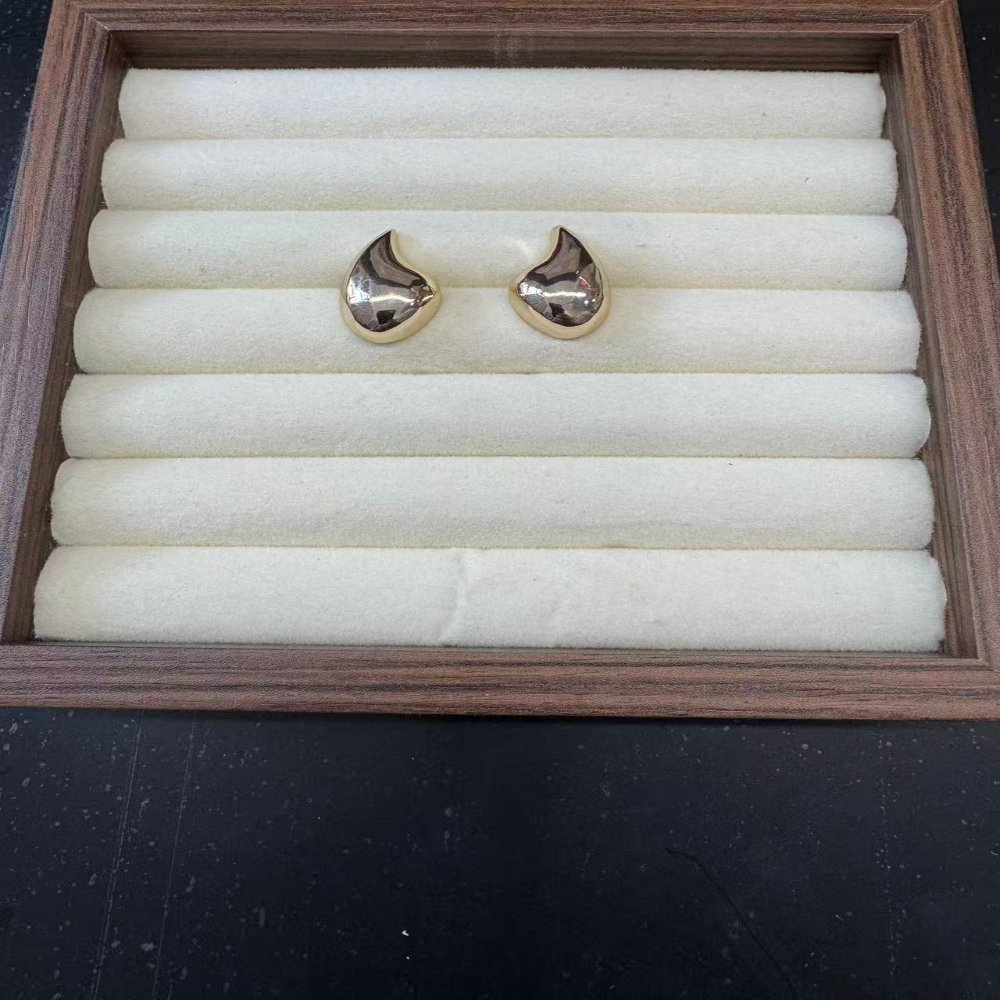
For a stud earring RFQ, define the supply unit and list every component that the quoted sample must include. Link a pair ID to the visible earring fronts, then request rear views and written confirmation of the attachment and any separate backings. Two pieces in a catalogue photograph do not, by themselves, establish a complete supplied pair, the contents of its package or the construction hidden behind the fronts.
Use the front view to identify the design
The official Sculpted Teardrop Gold-Tone Stud Earrings page shows two curved teardrop-shaped fronts. That is enough to identify the catalogue reference for a sample enquiry. The image does not show the entire rear assembly. Keep the product name as a reference label and ask the supplier to confirm the version being offered. Do not use the words gold-tone as evidence of precious metal content or a particular surface treatment.
Assign the sample a pair ID before sending the request. Put that ID beside the product link, the selected image and the requested catalogue variation. If the supplier sends another shape, size or attachment option, give the alternative its own ID. A component record works best when everyone can tell whether two messages concern the same pair or a suggested replacement. This prevents a convenient front photograph from becoming an ambiguous purchase specification.
Define the unit that the quotation counts
Write whether the requested quotation counts individual earrings, matched pairs, display cards or another explicitly described unit. Ask the supplier to repeat that unit in the quotation and packing proposal. A photograph of two fronts is not a reliable definition of a priced unit. The same design reference could be discussed as a sample, a pair or a packed assortment, so the written count needs to remain attached to the commercial line.
Next, separate the components attached to the earring from any loose parts supplied alongside it. Ask for the name, quantity and relationship of each component rather than guessing a backing type from the catalogue category. Record whether a display card, pouch or other presentation item is included, optional or excluded. A sample photographed on a tray does not show that the tray is part of the supply.
Component question | What the buyer should specify | Evidence to request
Counted unit | Individual piece, matched pair or named pack | Quotation line using the same unit
Earring fronts | Exact design and pair ID | Front image linked to the sample
Rear attachment | Supplier-confirmed construction and quantity | Clear rear and side views
Separate backings | Included, optional or excluded | Component list and assembled sample
Presentation items | Card or pack contents if requested | Pack layout with its own reference
Request views that answer the missing questions
Ask for a rear view showing both earrings and any separate components in the same identifiable sample record. A side view can help the buyer understand the relationship between the decorative front and the attachment. These requests are about identifying supplied parts. They do not establish wear comfort, retention performance, allergy suitability or a material grade, which would need their own defined requirements and evidence.
If the supplier uses a construction term unfamiliar to the buying team, ask for a labelled image rather than substituting a presumed equivalent. Keep the supplier wording alongside the buyer component code. Where the supplier offers more than one option, request a separate sample reference for each. Do not combine the front view of one version with the rear view of another and call the result a confirmed complete sample.
Check the pair relationship without assuming symmetry
A pair can use two matching fronts or a deliberately different arrangement. Ask the supplier which relationship applies to the selected reference and what orientation should be used on a display card. Curved or sculpted designs can appear different when rotated. The buyer should approve the intended presentation using labelled sample views, rather than describing a rotated piece as incorrect before the intended arrangement is understood.
Use a small receiving checklist that identifies the pair ID, component counts and requested presentation. If a component is missing from the sample, note it as a sample exception and ask whether the quotation still includes it. Do not turn the incomplete sample into a new supply definition by accident. Receiving staff should be able to distinguish an agreed exclusion from a part that simply was not present during the first review.
• Confirm the quotation unit and sample pair ID together.
• List attached and loose components separately.
• Ask for rear and side views when the catalogue only shows the front.
• Record presentation orientation and sample exceptions in writing.
Freeze the component record before an order revision
Once the sample contents are agreed, give the component record a revision identifier and retain the supporting views. Ask the supplier to identify any later substitution or omission against that revision. A changed backing or presentation item should be visible in the discussion even when the earring front looks unchanged. Keep commercial terms and separately requested declarations connected to the item, but do not infer those terms from the sample photograph.
A useful final confirmation says which pair was approved, how many of each component belong to the supply unit and which packaging items remain optional. It also lists unresolved questions openly. Send the record through the official contact channel so the supplier can correct it before the buyer relies on it. The goal is a complete and understandable component agreement, rather than a promise about performance that the front image cannot support.
Frequently asked questions
Does a two-piece photograph prove that backings are included?
No. It identifies the pictured fronts. Ask the supplier to list the supplied components and provide an identifiable rear view before treating any backing as included.
Can gold-tone be entered as a precious metal specification?
No. Here it is part of the supplier catalogue label and visible color description. Request the order-specific composition and finish information separately.
Should presentation cards share the earring pair ID?
Link the card reference to the pair ID, but identify the card separately when its layout or contents can change. That keeps the earring definition and the packaging revision traceable.
Product and contact references
Catalogue reference: confirm matching item: https://rumeijewelry.com/product/sculpted-teardrop-gold-tone-stud-earrings/
Related catalogue reference: https://rumeijewelry.com/product/hollow-heart-zircon-pendant-earrings/
Contact Rumei Jewelry: https://rumeijewelry.com/contact/
Rumei Jewelry blog: https://rumeijewelry.com/blog/