
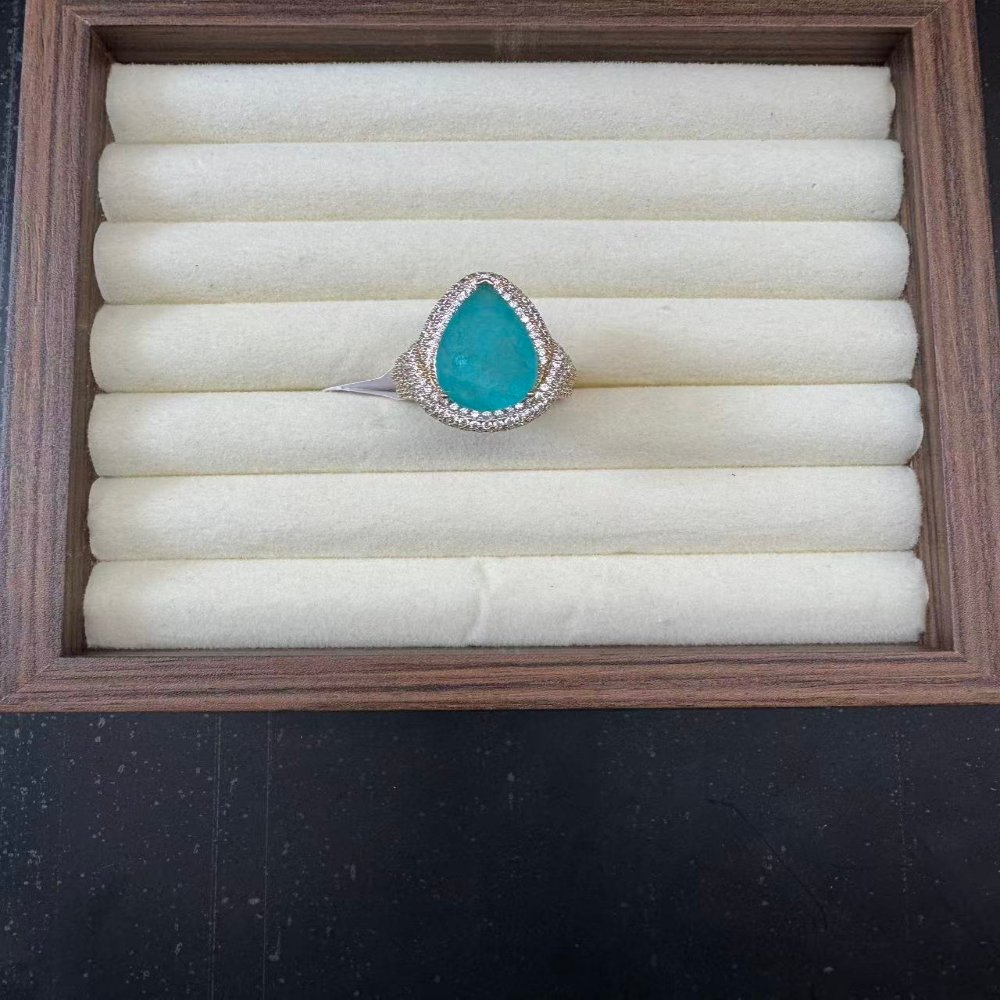
For a wholesale ring sample RFQ, identify the exact catalogue item, then draw a measurement map that separates the decorative head, the band and the finger-fit reference. Ask the supplier to confirm the measuring points, units and sample identity before comparing quotations. A face photograph can help locate a design, but it cannot establish the internal fit size or explain what an unlabelled dimension measures.
Start with one identifiable ring reference
The official Aqua Teardrop Halo Ring page provides a useful starting reference: its photograph shows a teardrop-shaped colored center surrounded by smaller light-colored accents. Use that page name and link to identify the requested design. Treat words describing stones or metals as supplier catalogue terminology until the particular order has a written specification. The RFQ should connect an image to an item record without turning its appearance into a material certificate.
Give the reference its own sample ID and attach the actual catalogue image used by the buying team. Record the date and the requested variation separately. If a supplier offers a visually similar alternative, require a separate alternative ID. Otherwise, a quotation for another head shape or band arrangement can look like a price change for the original ring. Keeping alternatives separate makes the first sample comparison much easier.
Separate face dimensions from the fit reference
A dimension beside a product photograph needs a datum: the precise points between which the measurement is taken. A ring head may have a length and width, while the band has other relevant dimensions. None of those labels automatically names the size that will fit a finger. The catalogue page includes a specification line, but the RFQ should ask the supplier to identify its endpoints rather than assume that it describes the internal opening.
Use an annotated front view for the decorative face and request the additional views needed to explain the band. Ask which sizing system is being quoted and how the supplier identifies the submitted sample within that system. Do not silently convert between systems or substitute a photograph-based estimate. If the sample is adjustable, require the supplier to state that explicitly and explain the applicable measurement condition; do not infer adjustability from a partially hidden band.
Record field | Buyer question | Supplier response to keep
Decorative head | Which outer edges define length and width? | Annotated view with units
Band reference | Where is the band measurement taken? | Location and measurement condition
Fit designation | Which sizing system identifies this sample? | Named system and sample designation
Sample identity | Is the measured item the photographed reference? | Sample ID and dated confirmation
Make the measurement method reproducible
Ask for a measurement photograph in which the item and the relevant measuring points can be understood together. A close-up number without a recognizable part of the ring is difficult to audit. The record should say whether the sample is measured freely, supported in a particular position or placed on a named sizing tool. That explanation is especially useful when a raised decorative head prevents the ring from sitting flat.
Keep requested tolerances separate from observed sample readings. The buyer may propose an acceptance range, but the supplier needs to confirm whether that range applies to the quoted version. An observed reading is not automatically an agreed production limit. Where the method remains unclear, mark the field for clarification instead of replacing it with a guessed number. This preserves a useful distinction between what was seen and what was accepted.
Compare samples before comparing price lines
Prepare the comparison sheet so that each supplier response uses the same field names. Check the reference image, sample ID, fit designation and measuring method first. Then compare the stated measurements. Two quotations can refer to similar-looking rings while using different sample sizes or decorative head proportions. A lower quoted price is hard to interpret until the physical reference and requested supply unit are aligned.
If a revised sample arrives, retain the earlier record and add a revision note. Identify exactly which measurement or feature changed and whether the buyer accepted it. Avoid updating the old sample row in place, because that can make the first quotation appear to describe a later sample. A short revision history helps the purchasing, merchandising and receiving teams work from the same reference when the order is reviewed.
• Check the catalogue link and sample ID before interpreting any dimension.
• Keep decorative head measurements and finger-fit references in separate fields.
• Request an explanation for every unlabelled or conflicting specification.
• Record acceptance against the confirmed sample revision, not a similar image.
Send a concise RFQ confirmation package
Send the annotated map, requested sample IDs and comparison sheet together through the supplier contact channel. Ask the supplier to mark unknown or unavailable fields rather than copying a generic size description. Keep material declarations, commercial terms and any requested supporting documents in their own sections. This allows the measurement discussion to remain precise without suggesting that a visual review has already verified composition, authenticity or performance.
Before releasing a purchase instruction, resolve any disagreement between the page, quotation and physical sample. Record the agreed reference in plain language and retain the supplier response with the sample photographs. The result should be a traceable measurement conversation: anyone reopening the file can understand which ring was discussed, which points were measured and which details still require confirmation. It does not require inventing a universal fit recommendation.
Frequently asked questions
Can the catalogue face dimensions be used as the ring fit size?
Not without clarification. Ask what the dimension measures and request a separately named fit designation. Decorative head dimensions and finger-fit references answer different purchasing questions.
Does the photograph verify the center material or metal purity?
No. Use the photograph to identify the sample appearance. Request the order-specific material declaration and any relevant evidence separately, without treating a catalogue name as independent verification.
What should happen when the quotation and sample measurements differ?
Keep both records, ask the supplier to identify the relevant sample revision and resolve the difference in writing before accepting the reference. Do not silently overwrite the earlier reading.
Product and contact references
Catalogue reference: confirm matching item: https://rumeijewelry.com/product/aqua-teardrop-halo-ring/
Related catalogue reference: https://rumeijewelry.com/product/sculpted-teardrop-gold-tone-stud-earrings/
Contact Rumei Jewelry: https://rumeijewelry.com/contact/
Rumei Jewelry blog: https://rumeijewelry.com/blog/